


“Right after I graduated, I interned with the Arms Control Association. It was terrific.”
Daniel Ellsberg (1931-2023)
July/August 2023
By George Perkovich
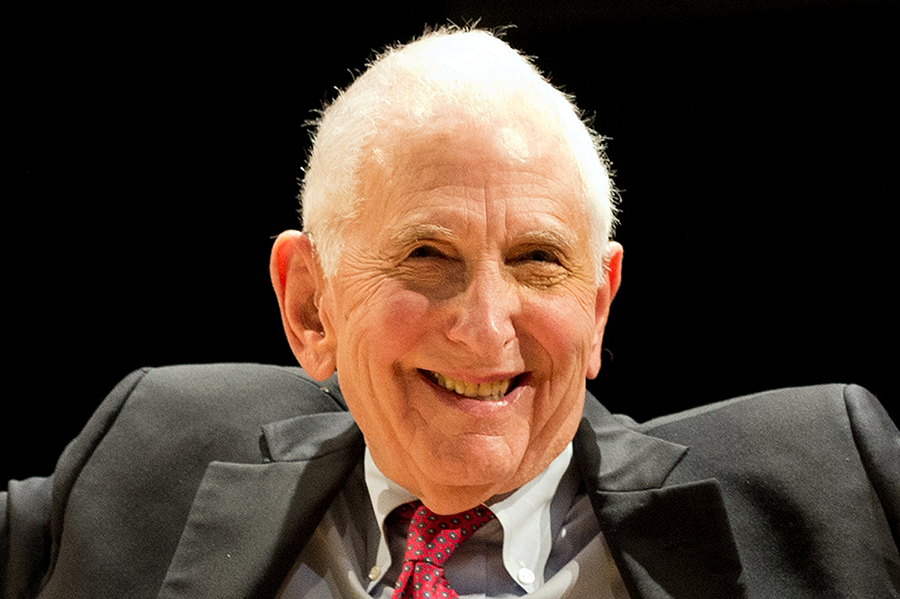
Born in Chicago in 1931 and raised largely in Detroit, he went to Harvard University on a Pepsi-Cola Co.-funded scholarship not long after losing his mother and sister to a car accident when his father fell asleep at the wheel. The accident left Ellsberg in a coma for 36 hours.1 After graduating third in his class with an economics degree from Harvard in 1952,2 Ellsberg enlisted in the U.S. Marines.
Everyone who met Ellsberg quickly recognized his brilliance. In conversation, his mind raced ahead and around corners while his interlocutors were still pondering his first point. In his Harvard doctoral dissertation in 1962, he presented a game theoretical decision-making tendency that remains famous among economists as the Ellsberg Paradox. The ultimate U.S. warrior in Vietnam, John Paul Vann, said that Ellsberg had “the most brilliant mind ever exposed to the realities of Vietnam.”3 Henry Kissinger called him “the most brilliant paranoic” he knew.
He was exceptionally courageous, almost manically so. Yet, he did not have a death wish and dedicated his long life to political struggle. “Dan raged without ever being pious,” his friend, the great Indian novelist and activist Arundhati Roy, told me. “He was brilliant and unafraid of taking sides without ever simplifying what he wanted to say.”
Ellsberg’s courage may have come from relentless curiosity. He loved to question things and chase answers, however dangerous that might become. After Harvard and extremely sensitive work on nuclear war planning at the RAND Corp. and the Pentagon, covered fascinatingly in his second memoir, The Doomsday Machine: Confessions of a Nuclear War Planner, Ellsberg sought to rejoin the Marines in Vietnam, but he was told that his security clearances made it too risky in case he was captured. So, Ellsberg found a position doing field work trying to improve pacification programs in the countryside. U.S. soldiers and foreign service officers saw him as one of a small band “who cared and dared.”4
One of the more astounding stories in The Doomsday Machine is Ellsberg’s belated discovery that his father had been a nuclear dissident too. In late 1949, Harry Ellsberg had resigned his lucrative job as a lead structural engineer at a firm that helped build the Hanford plutonium-production plant in Washington state. Yet, Dan never knew why until a conversation in 1978 when his father told him he left the job “because they wanted me to help build the H-bomb [and] I didn’t want to make an H-bomb.”7 Dan protests that this cannot be correct because President Harry Truman’s decision to proceed with the H-bomb was not made until January 1950, and the whole subject was “supersecret.” His father explained that “somebody had to design [the necessary plutonium-production] plant if they were going to go ahead. I was the logical person. I had a Q clearance.” Ellsberg said, finally, “‘Dad, how could I not ever have heard of any of this before? How come you never said anything about it?’ My father said, ‘Oh, I couldn’t tell any of this to my family. You weren’t cleared.”’8
Ellsberg was not always a critic of government. He began his career as a conservative hawk trained on game theory. It was experience in the Defense Department and the adjacent RAND Corp. that made Ellsberg a critic of government. He encountered nuclear war planning that was irrational or at least needing much more debate and public consent. This is conveyed in a passage of The Doomsday Machine that illuminates much of his life’s work.
For several years [beginning in late 1960] one of my highest objectives for my own personal influence on national defense was moving a few pieces of paper from one level of authority to a higher one, from a military to a civilian level. In particular, I wanted to move one document, the JSCP [Joint Strategic Capabilities Plan] with its Annex C, from the offices of the Joint Staff or Air Staff to the Office of the Secretary of Defense and to the Oval Office, so that civilian authority could become aware of and then act to control and change the nature of our general war plans. (A decade later, my personal objective was very similar, with a different level of civilian authority in mind: I wanted to move seven thousand Top Secret pages—the Pentagon Papers—from the Pentagon and RAND to the Senate and the American public).9
This motive was honorable and, in practice, outrageously difficult to achieve. In a revealing story, Ellsberg recounts how the U.S. Joint Chiefs of Staff tried to deceive President John Kennedy’s national security advisor, McGeorge Bundy, and Deputy Defense Secretary Roswell Gilpatric by giving them what the Joint Chiefs portrayed as the nuclear war plan but was in fact a sanitized, less crazy version. Drawing on his memory of a copy of the actual JSCP that he had seen earlier while at RAND, Ellsberg alerted these civilian leaders and later borrowed a copy from a friend in the Pentagon. With Gilpatric’s blessing, Ellsberg then drafted pointed questions for the Joint Staff and their chiefs while feigning that the civilians had not actually seen the military plans.
“The questions were the message,” Ellsberg writes. “They were intended to leak into the [Joint Chiefs] the news that their processes, their conflicts, compromises, and maneuvers, had become transparent to the Office of the Secretary of Defense.” Among the questions, indicative themselves, were, “To what extent, and in what precise ways, does the planned attack upon urban-industrial centers and bonus targets differ from an attack intended to maximize population loss in the Soviet Union? In Communist China? Does the plan procced on the assumption that it is national policy to hold the population of the USSR and Communist China responsible for acts of their governments? Are Communist Chinese people held responsible for acts of the Soviet government?”10
As far as Ellsberg knew, the Joint Chiefs never answered the questions, although they knew that the White House had approved of them. To Ellsberg’s surprise, the Joint Chiefs did answer a related question: how many people would die as a result of the plan’s successful execution. The answer was 600 million in and around the Soviet Union and China.11 Ellsberg concluded that this was evil, whatever the character and intentions of the plan’s authors.
The insight that motivated so much of Ellsberg’s work for 60-plus years was that leaders, as human beings, are fallible and often banal, easily captured by the prevailing institutional mindset. Sound decision-making requires multiple angles of analysis and prescription with rigorous debate among them. The analysis and debate should be informed by all relevant data, not just the data that supported the position of the group conducting the deliberation. Where uncertainty is a fact because the right data do not exist, admit it.
In his memoir Secrets, Ellsberg recalls this profound warning to Kissinger as he was about to take office as Nixon’s national security advisor:
You’ve been a consultant for a long time, and you’ve dealt a great deal with top secret information. But you're about to receive a whole slew of special clearances, maybe fifteen or twenty of them, that are higher than top secret. … [I]t will have become very hard for you to learn from anybody who doesn’t have these clearances. Because you’ll be thinking as you listen to them: ‘What would this man be telling me if he knew what I know? Would he be giving me the same advice, or would it totally change his predictions and recommendations?’ And that mental exercise is so torturous that after a while you give it up and just stop listening.… You will deal with a person who doesn’t have those clearances only from the point of view of what you want him to believe and what impression you want him to go away with, since you’ll have to lie carefully to him about what you know. In effect, you will have to manipulate him. You’ll give up trying to assess what he has to say. The danger is, you’ll become something like a moron. You’ll become incapable of learning from most people in the world, no matter how much experience they may have in their particular areas that may be much greater than yours.13
I have sensed this tension in many conversations with U.S. government officials and have found only a few who appeared to recognize the risk of entrapment in secrecy and the need to get out of offices and meeting rooms and go out and see and hear the people and places that will be affected by their prospective policies and actions.
Such processes of quality control are most important when war is the question, especially nuclear war. Time and again, Ellsberg saw decision-making processes being corrupted or short-circuited by the withholding of information. “[W]hat seems to me beyond question is that any social system (not only ours) that has created and maintained a Doomsday Machine and has put a trigger to it, including first use of nuclear weapons, in the hands of one human being—anyone, not just this man, still worse in the hands of an unknown number of persons—is in core aspects mad. Ours is such a system. We are in the grip of institutionalized madness.14
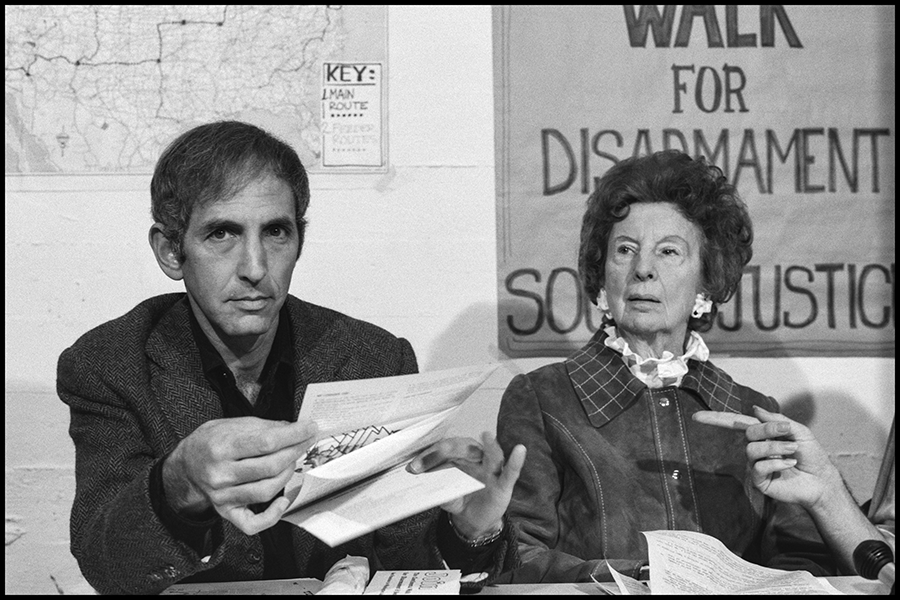
This idea animated Ellsberg from the 1980s and beyond. It was manifested in a multi-year research and advocacy project, which he dubbed The Manhattan Project II and was aimed at seizing upon the end of the Cold War to accelerate nuclear disarmament.
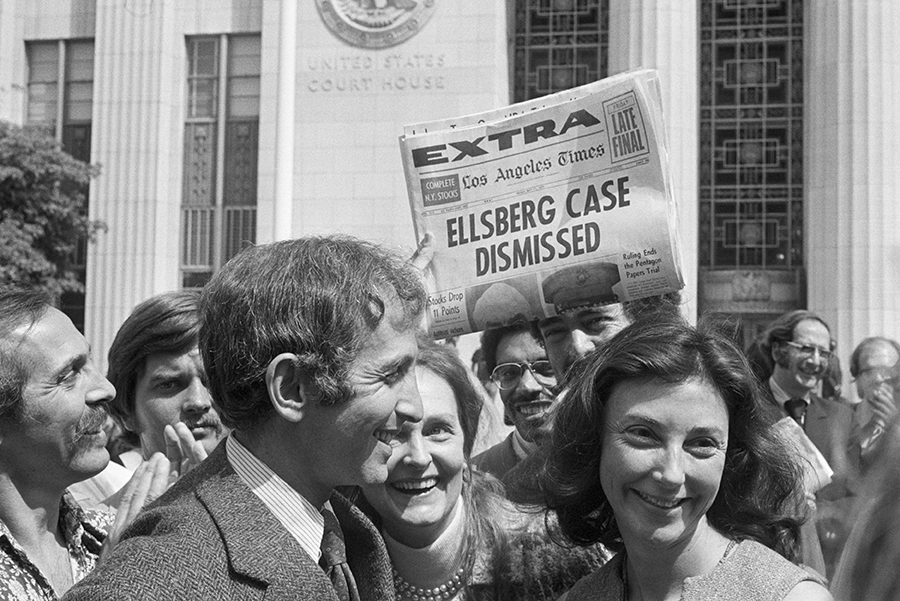
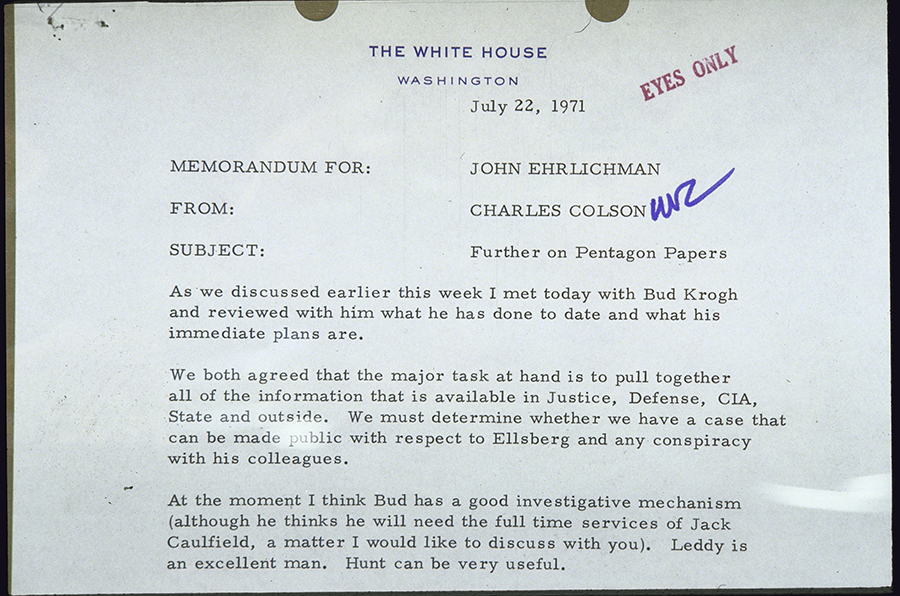
Daniel Ellsberg was an American original. He had a talent and drive greater than most others, in a country whose power befitted and then horrified him. He would have been jailed or killed in Russia and China. In Nixon’s America, Ellsberg’s psychiatrist’s office was burgled; plots were hatched to spike his drink with LSD and to pummel him on the Capitol steps; but ultimately, he was brought to a court of law, and the judge dismissed his case due to government impropriety. Only in America. Yet, I cannot leave it there. I wish I could have asked him, before he died on June 16 at the age of 92, if he believed that in a 2020s Republican administration he would receive the protection from law and judges that he received 50 years ago.
ENDNOTES
1. Neil Sheehan, A Bright Shining Lie (New York: Random House, 1988), p. 590.
7. Daniel Ellsberg, The Doomsday Machine: Confessions of a Nuclear War Planner (New York: Bloomsbury, 2017), p. 291.
12. Neil Sheehan, Bright Shining Lie, p. 593.
13. Daniel Ellsberg, Secrets (New York: Penguin, 2003), pp. 237-239.